UC Riverside graduate student Erfan Shayegani has been named a 2026 MLCommons Rising Star, an honor recognizing emerging researchers whose work is helping shape the future of artificial intelligence (AI) and computing systems.
MLCommons is an international AI engineering consortium that brings together industry and academia. It selected only 39 researchers worldwide as this year’s “rising stars.”
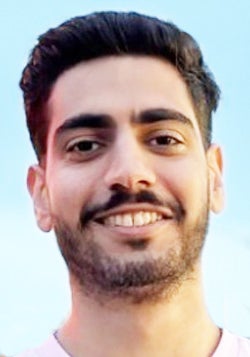
Shayegani is a fourth-year doctoral student in the Department of Computer Science in the Bourns College of Engineering. His research examines how society can ensure that multimodal language models and AI agents remain safe, trustworthy, and aligned with human values, with a focus on safety, ethics, fairness, robustness, privacy, and security.
“Being selected as an MLCommons Rising Star is a tremendous honor,” Shayegani said. “It reflects the importance of ensuring that increasingly capable AI systems behave safely and responsibly when interacting with the real world.”
Shayegani was most recently the lead author of a study that drew international attention for identifying potentially dangerous flaws in a new generation of AI systems known as Computer-Use Agents, or CUAs, that perform tasks such as interacting with files and applications, or organizing emails while users are away from their computers. In collaboration with UCR faculty members and computer scientists from Microsoft and NVIDIA, he found that these systems can inadvertently cause harm while blindly carrying out tasks assigned to them, a phenomenon Shayegani and his co-authors call “Blind Goal-Directedness.”
In April, the study was presented in Brazil at the International Conference on Learning Representations, or ICLR, one of the world’s leading academic conferences focused on AI and machine learning. The findings arrived as major technology companies are racing to deploy increasingly capable AI assistants that can access email accounts, financial records, and other sensitive information. Shayegani said the work highlights the need for stronger safeguards before such systems become commonplace.
In 2024, he was the lead author of another paper that identified security flaws in vision-language AI models that can allow bad actors to use AI for nefarious purposes, such as obtaining instructions on how to make a bomb. He found that the vulnerability occurs when the malicious goal is carried out in two modalities, putting the harmful content in the visual modality, such as images, while leaving the text modality benign. This phenomenon, called “Cross-Modality Safety Alignment,” has been widely recognized by the computer science community and his paper has been cited over 348 times.
In addition to his work at UCR, Shayegani completed research internships at Microsoft Research and Microsoft’s AI Frontiers and AI Red Team, where he helped investigate safety and trustworthiness issues in advanced AI systems. He is currently completing a research internship at Apple while continuing his doctoral studies at UCR under the guidance of computer science professors Nael Abu-Ghazaleh and Yue Dong.
The MLCommons selection recognizes not only Shayegani’s accomplishments to date but also his potential to help guide the next generation of AI research.