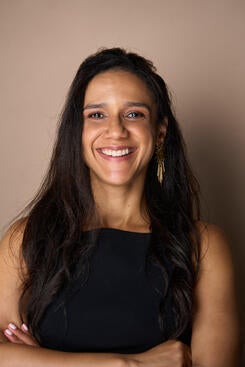
Erika Villeroy da Costa, a graduate student in critical dance studies at UC Riverside, has been awarded a 2026 Mellon/ACLS Dissertation Innovation Fellowship.
Da Costa will use the $52,000 grant to support her research on first-generation members of an Afro-Brazilian dance troupe founded by the pioneering dancer, choreographer, and teacher Mercedes Baptista.
Baptista played a crucial role in bringing Black Brazilian culture into the formal dance world of Brazil, developing a style that blended classical ballet with Afro-Brazilian religious and cultural forms.
“Drawing on archival research, oral histories and choreographic analysis, this project traces the records and stories of the first-generation members of Balé Folclórico Mercedes Baptista, attending to the limits of redress, and the interplay between hypervisibility and erasure of Black dance makers within broader narratives of pioneerism in modern dance histories,” da Costa writes in an abstract of the project. “Interrogating lone-person accounts and rendering visible material networks of dance transmission through and as black sociality, it investigates how documents can be reinterpreted through absence, residue and fullness as resources in archival practice and collective memory work.”
A performer, teacher, and assistant choreographer, da Costa has collaborated with dance companies in her native Brazil and is actively involved in the integration of Afro-Brazilian traditional and contemporary dances in the country’s college-level dance education curriculum. She earned a bachelor’s degree from the Angel Vianna School and College of Dance and a master’s degree from Fluminense Federal University. (Both institutions are in Rio de Janeiro.)
Da Costa was among the 50 graduate students selected for the fellowship from a pool of more than 1,000 applicants. The fellowship is supported by the Mellon Foundation and intended “to support emerging scholars as they pursue bold and innovative research in the humanities and interpretive social sciences,” according to the American Council of Learned Societies.