A UC Riverside chemical and enviromental engineering professor and his longtime industry collaborator have received an American Chemical Society award for research aimed at making catalysts more effective at removing harmful pollutants from vehicle exhaust.
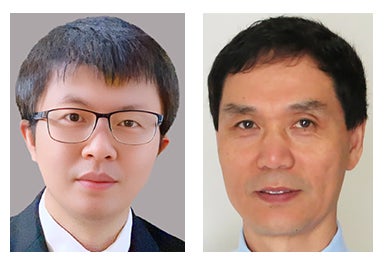
Fudong Liu, a professor of chemical and environmental engineering, and Yuejin Li, a senior principal scientist from BASF Environmental Catalyst and Metal Solutions, received the 2026 Colloid and Surface Technology Award from the ACS Division of Colloid and Surface Chemistry. The award recognizes researchers who translate advances in surface science into practical technologies that benefit society.
“This award underscores the importance of collaboration between academia and industry for colloid and surface science, and heterogeneous catalysis research,” Liu said. “Universities can provide the fundamental scientific understanding, while industry brings experience with the challenges of putting new catalyst technologies to work in the real world.”
Their seven-year collaboration, supported through research sponsorship from BASF Environmental Catalyst and Metal Solutions, has centered on improving catalyst surfaces to reduce harmful vehicle emissions. Catalysts speed up chemical reactions without being consumed by them. In vehicle exhaust systems, they convert harmful pollutants into less harmful substances before they leave the tailpipe.
Colloid and surface science examines how extremely small particles and interfaces behave. In catalyst research, these principles allow scientists to tailor the size, composition, distribution, and local environment of active materials, thereby influencing how chemical reactions proceed at a catalyst’s surface.
Liu and Li have used these principles to engineer the microscopic neighborhoods where pollution-removing reactions take place. By controlling how metals and other materials meet at a catalyst’s surface, they can change how effectively pollutants are captured and converted to harmless substances.
In one study, Liu, Li, and other collaborators paired platinum catalysts with porous materials called zeolites. Under operating conditions, the zeolites created a water-rich environment around the platinum that changed how molecules interacted with its surface. The result was improved low-temperature removal of nitrogen oxides, or NOx, which react with other pollutants in the atmosphere to contribute to the formation of unhealthy ground-level ozone pollution and smog.
Li is a Senior Principal Scientist and expert at BASF Environmental Catalyst and Metal Solutions and has helped develop catalytic systems used in diesel passenger cars, heavy-duty trucks, gasoline vehicles, and engines powered by alternative fuels.
Liu is a Professor in UCR’s Department of Chemical and Environmental Engineering and is affiliated with the university’s Center for Environmental Research and Technology (CE-CERT), the Materials Science and Engineering (MSE) Program, and the Center for Catalysis.
The scientists were honored at the ACS Fall Meeting, held Aug. 23-27 in Chicago. Each received a plaque; together, they shared a $3,000 honorarium and $1,000 in travel support.
They presented an award lecture that explained how they translated concepts in colloid and surface chemistry into practical catalyst design for emission control, using colloidal materials primarily as well-defined platforms to control metal dispersion, interfacial structure, and surface reactivity.