At a time when American democracy seems fragile, New York Times columnist Jamelle Bouie described how the post-Civil War era offers a lens to view the current state of the nation.
An award-winning journalist, Bouie was the speaker for the 57th Annual Hays Press-Enterprise Lecture at UC Riverside’s University Theatre on Thursday, April 2. His talk was titled “What’s the Matter with American Democracy?”
Bouie said he approaches his role as a columnist writing about politics and race as an extended act of “public deliberation.” Over time, he’s been making the case that “the U.S. is in a kind of crisis of democracy.”
Joking that he’s a history buff who reads Supreme Court arguments for fun, Bouie said it’s important to know American history to understand today’s issues, noting that the country wrestled with some of the same questions before.
Bouie said the actions of each presidency can be viewed as an argument about the nature of the country. With President Donald Trump, it’s about how he views the American people, he said.
“In Donald Trump’s view, this is not a capacious nation of many peoples committed to a set of ideals,” Bouie said. “This is instead a homeland for a specific set of people defined by race, religion, and nationality.”
“Those people, this specific group, are not just one group among equals, but the rightful owners of the nation, entitled to prestige and status and everything that comes with them. And everything the administration does is in service of trying to prove this point.”
Those questions were at the forefront of the Reconstruction era of 1863 to 1877, following the Civil War and abolition of slavery, Bouie said.
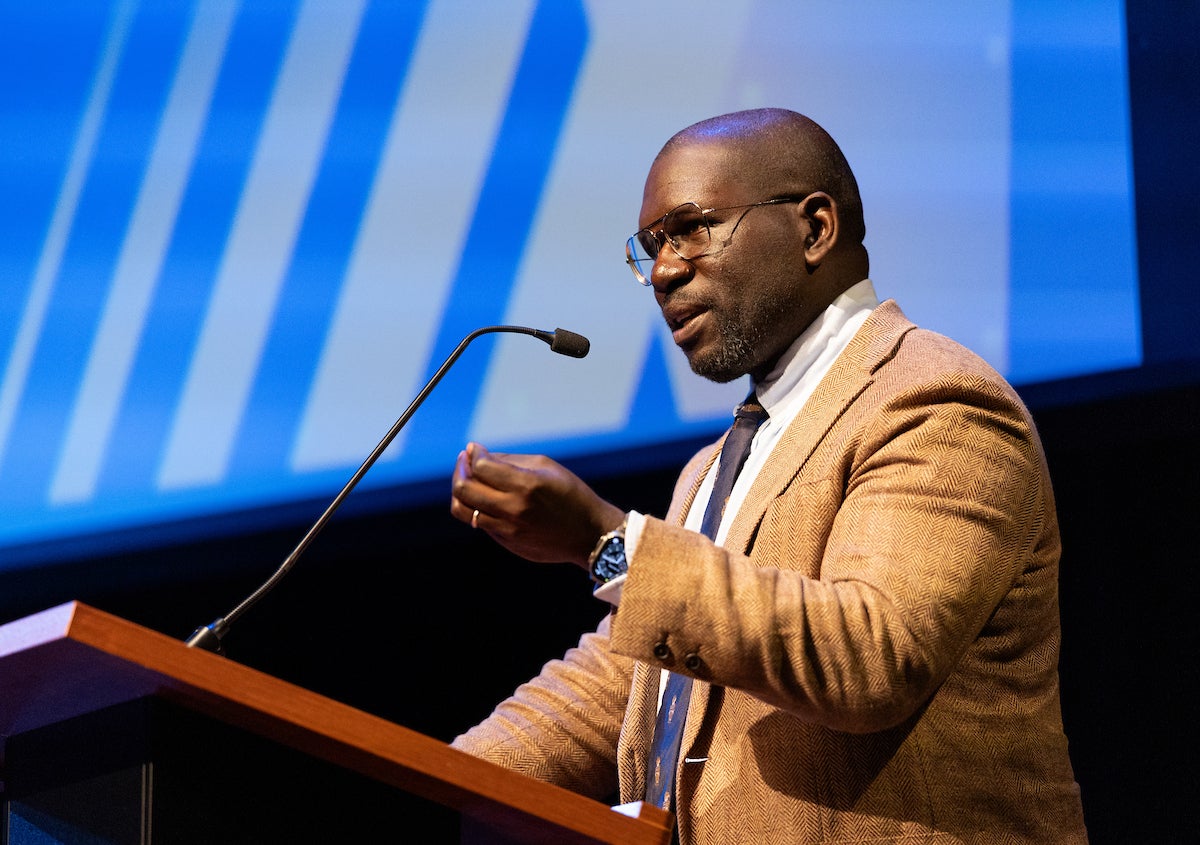
He described competing ideas of American freedom during Reconstruction from the formerly enslaved seeking full rights as Americans to former slaveholders who did not view their freedom as legitimate and used Jim Crow laws to strip them of equal rights.
“Who can claim full membership in the political community, and what exactly is American freedom? Is it the freedom of all people here to pursue life, liberty, and happiness, or is it something much more limited, a privilege for the few, free to exercise their power as they see fit?” Bouie said.
During Reconstruction, the 13th, 14th, and 15th amendments to the U.S. Constitution were passed. They abolished slavery and prohibited the use of race in denying the right to vote. The 14th Amendment established birthright citizenship, which the Trump Administration is trying to overturn with a case that went before the U.S. Supreme Court the day before Bouie’s lecture.
“That is what we're ultimately arguing about, whether this country is going to be for everyone, whether it will offer opportunity to everyone, or whether it's going to be a playground for a select few of very wealthy people who can then exclude whom they want on whatever basis they want,” Bouie said.
That’s why Reconstruction matters because that project of trying to build an equal society in the U.S. never ended, he said.
“Reconstruction will always be a time that we go back to, to understand the highest aspirations this country has had, what it maybe looks like to try to bring those into being, and what we can learn from that effort to try to do that for ourselves in the present,” he said.
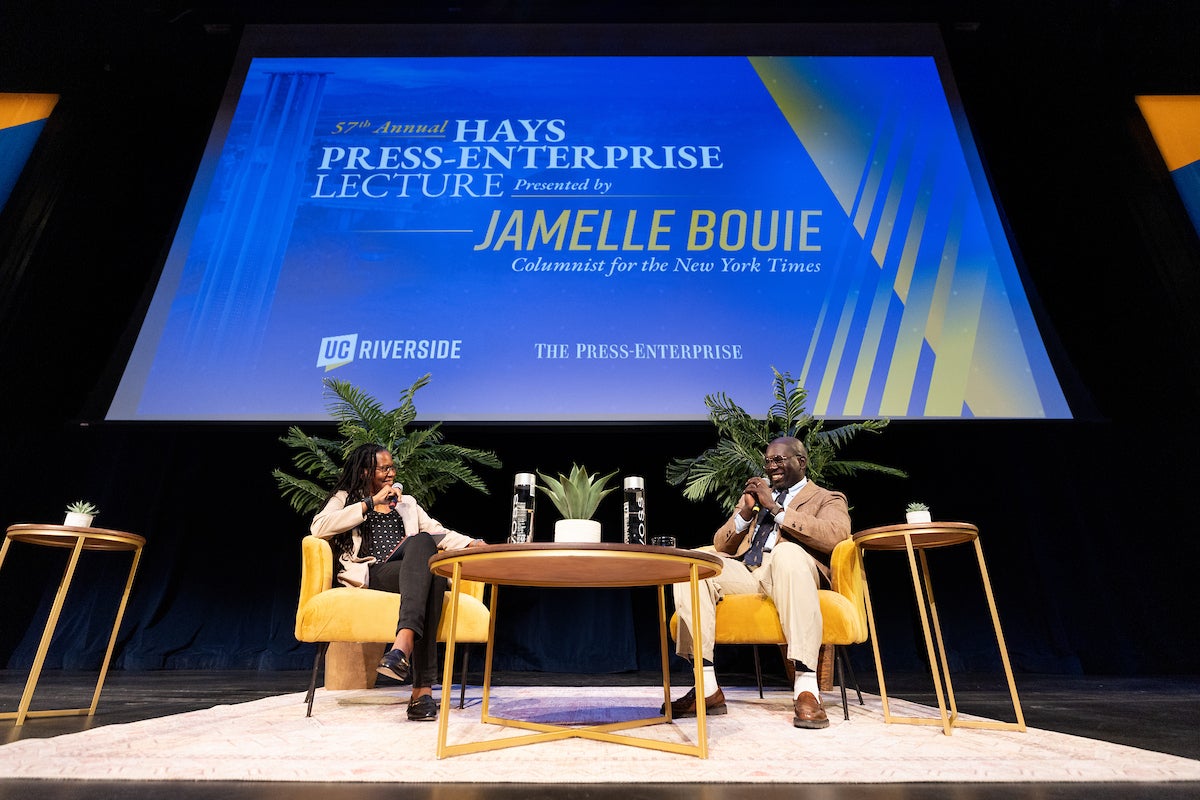
Following his talk, Bouie took questions from Myisha Cherry, a UCR associate professor of philosophy, delving deeper into the questions of what freedom represents, how democracy is a group project, and the importance of a free press.
Beyond just disseminating important news, “the free press helps create a public that can act democratically,” Bouie said.
During his campus visit, Bouie also met with students and answered their questions.
The Hays Press-Enterprise Lecture Series was established in 1966 by Howard H. “Tim” Hays Jr., in collaboration with UC Riverside. His son, Tom Hays, created an endowment fund to ensure the lecture’s tradition lived on after his father’s death in 2011.
The lecture series seeks to present notable journalists to address important topics. In recent years, presenters have included National Public Radio broadcaster Ari Shapiro, New York Times journalist Michael Barbaro, and broadcast journalist Soledad O’Brien.