As a lecturer at UC Riverside’s School of Business, Chuan Qin teaches modern finance and strategic management. But when she’s not in the classroom Qin is an accomplished performer, playing a traditional Chinese instrument that dates back over 2,000 years.
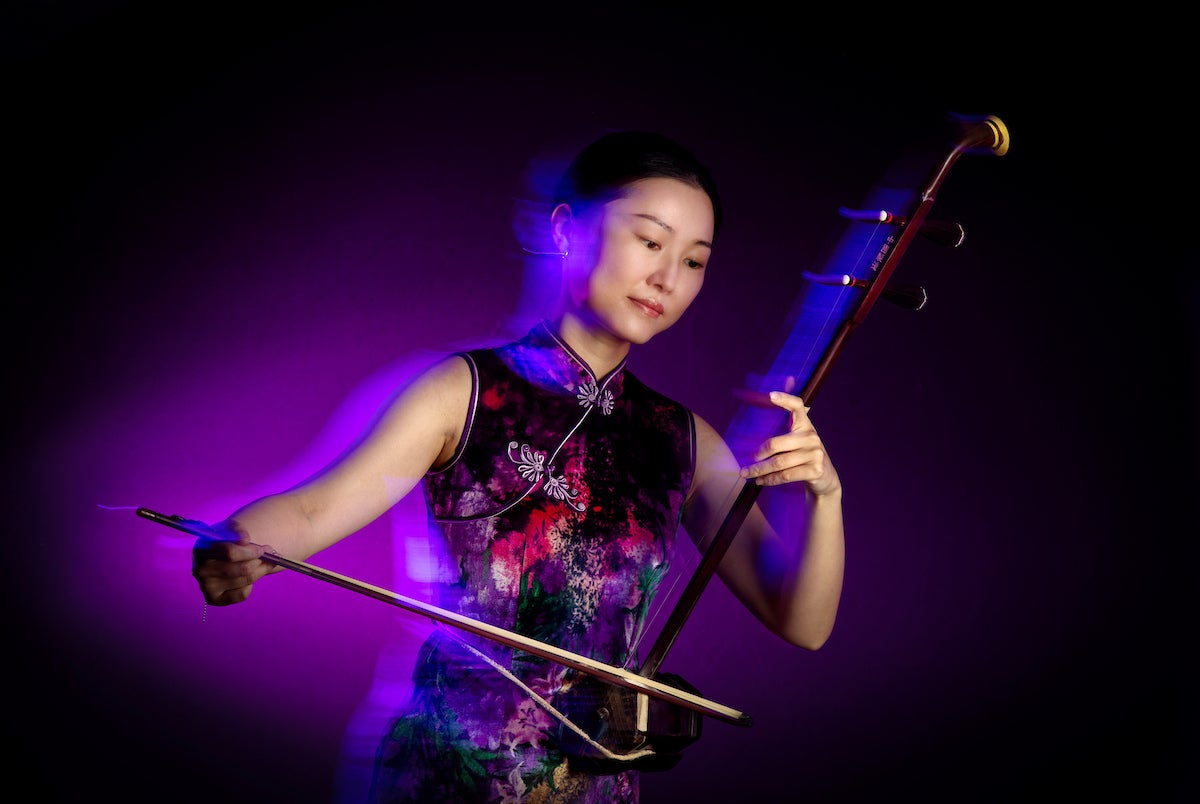
The erhu, pronounced R-hoo, is a two-string instrument similar to a violin or fiddle, often played as part of Chinese opera or orchestral music. It’s not as widely used in Western countries.
Qin, who has been playing the erhu for more than two decades, has used her skills to introduce new audiences to the instrument while also putting her own spin on how to play.
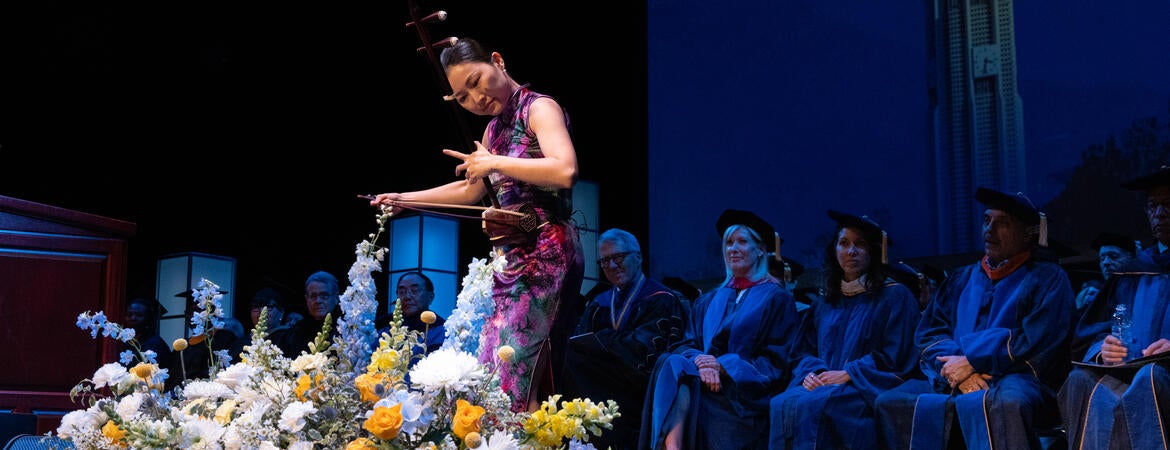
She recently performed at Chancellor S. Jack Hu’s inauguration in February, providing an upbeat musical start to the ceremonies that captivated the audience and university leaders on the stage.
It was a fitting return for her as she first began to blossom as a performer a decade ago as a graduate student at UCR, where she received her master’s degree in finance. She said she felt honored to perform at the ceremony.
“I feel a very deep connection to UCR,” said Qin, who began teaching on campus last fall after a decade working in the finance industry.
The chancellor had specifically requested an erhu performance at the inauguration. The inauguration organizers approached Qin after learning UCR had its own erhu player on campus. Hu also suggested the composition she played, “Spirit of the Horse,” a nod to 2026 as the Chinese Year of the Horse and its themes of momentum and progress.
It was also an example of how Qin subverts expectations with her erhu playing. The instrument is traditionally played sitting down, the music often sad or pensive. Qin played standing up, with the bottom of the erhu fastened to her waist, moving around the stage and encouraging the audience to clap as she played an energetic version of the song to a backing track with keyboards and drums.
It’s something she began incorporating into her playing over the years as she sought to blend Eastern and Western musical styles, Qin said.
“I did a little bit of innovation, making it more upbeat and putting more skill in the finger and bow playing,” she said.
Growing up in the Chinese city of Guangzhou, also known as Canton, Qin began playing the erhu when she was 7 years old. It was not the most popular instrument even in China but Qin said she was drawn to it, sometimes practicing for eight hours a day.
“I tried piano, I tried singing, dancing but it seemed like this instrument attracted me so much,” she said. “It was the shape of it, the sound of it, where my fingers just felt right on it. I feel like the music, the songs in erhu, are unique.”
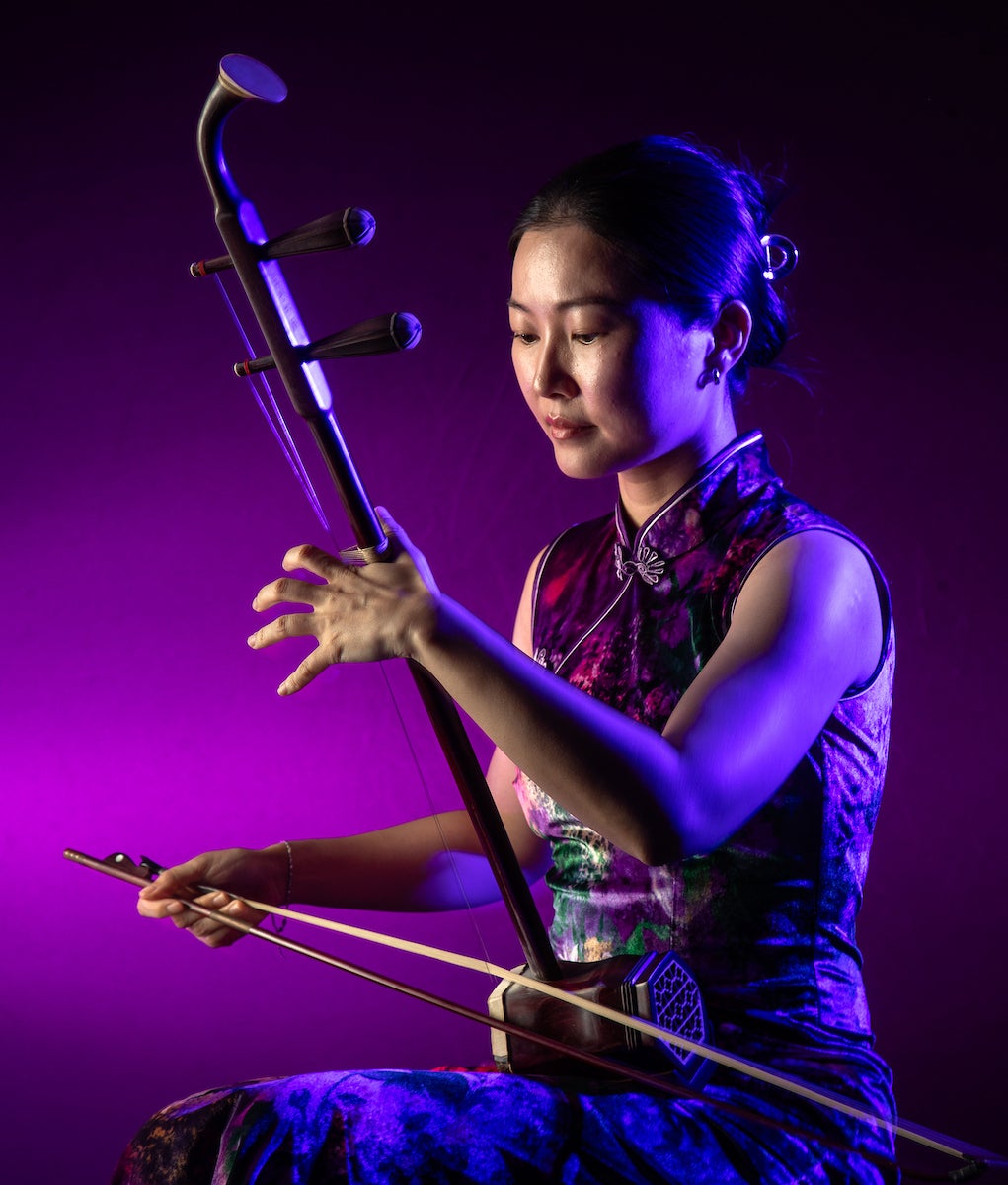
The erhu consists of a long vertical neck with two steel strings and a small sound box with a python skin covering that resonates the sound at the bottom. A wooden bow with a horse tail at the end is placed within the strings instead of over them.
The erhu that Qin plays, the fourth she’s had since she started, is made of red sandalwood although she also owns a porcelain one.
Qin first started performing in front of audiences when she was 9 years old at local school events and competitions and then later at city, province, state, and national level shows. She received a grade-ten certificate of erhu from the Chinese Musicians Association when she was 13 years old, signifying the top level of proficiency.
She kept playing, even as she went to university in China and then came to the United States as an exchange student to study business. When she brought her erhu with her, Qin saw it as an opportunity to introduce an instrument that many American audiences were unfamiliar with.
As a graduate student at UCR, she often performed outside Anderson Hall.
“I feel like I started to shine here because when I did a performance a lot of people came and I got so many invitations and performance opportunities after that,” she said.
Paulo Chagas, a professor of music, met Qin in 2015 when she approached him about performing. He said he was immediately struck by her talent, expressive musicality, and the emotional depth she brought to the instrument.
“The erhu has a distinctive and deeply human voice, capable of great nuance and lyricism, and Chuan Qin played it with both technical mastery and genuine artistry,” he said. “Her performance demonstrated not only the beauty of the instrument itself, but also her ability to connect with audiences across backgrounds and traditions.”
Chagas, who was chair of the music department at the time, organized a recital for her at the Culver Center of the Arts. Qin later gave a TEDxUCR presentation where she explained the erhu to audiences, demonstrating the different types of sounds it can make including mimicking animal noises.
After getting her master’s degree from UCR, Qin worked as a project manager for a Houston oil company and got her doctorate from the University of Newcastle in Australia.
She kept playing regularly, sometimes as a soloist and sometimes with an ensemble or band. She particularly enjoyed bringing the erhu to Western music to create a unique blend of sounds.
In Houston, she was first chair of the city’s Chinese Traditional Music Group and in Riverside founded Eastern Echo, a collective of Asian women who perform contemporary Eastern and Western folk music internationally.
Qin said she typically has at least one performance a month. She’s gone back to play in China but mostly gets invitations in the U.S. to play at private events. She has another UCR performance coming up on June 3 at the AAPI Recognition Celebration during commencement.
“Performing really gives me a lot of excitement and encourages me to keep going,” Qin said. “Once you’re on stage, just for a couple minutes, I feel very fulfilled.”
Watch Qin's performance at the inauguration ceremony (at 16:19). Watch Qin's TEDxUCR performance here.