Chia-Wei Yeh, a doctoral student in the Neuroscience Graduate Program at UC Riverside, has been awarded an American Epilepsy Society (AES) Predoctoral Research Fellowship, a competitive award that supports promising early-career investigators pursuing innovative epilepsy research.
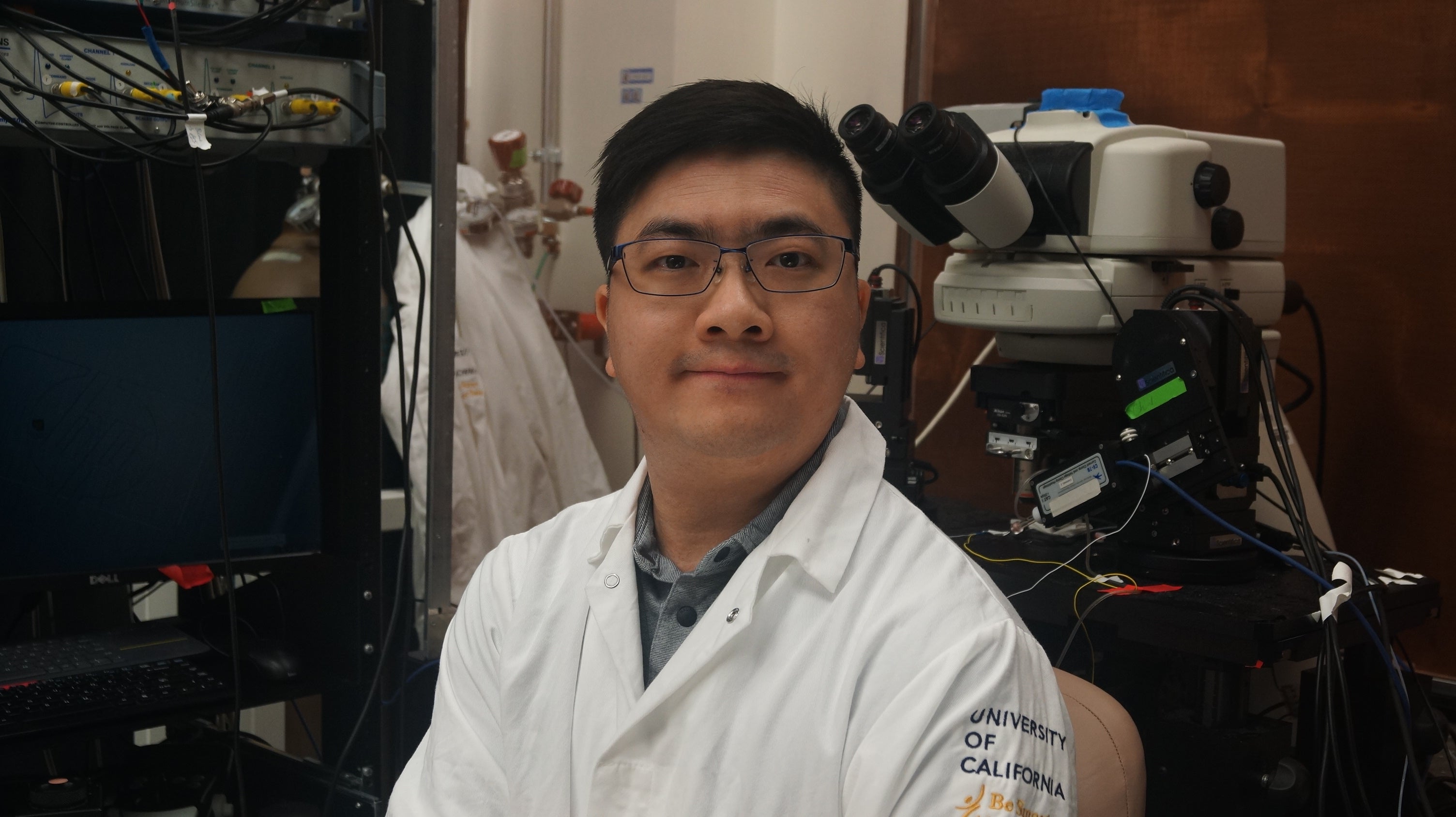
The fellowship provides $30,000 in funding, including $29,000 to support Yeh’s research fellowship stipend and benefits and $1,000 in travel support to attend the 2026 AES Annual Meeting. The award also includes complimentary registration for the annual meeting and membership in the AES, providing Yeh with access to educational programming and professional development resources.
Yeh’s research focuses on understanding how neuromodulatory inputs — chemical signals from brain cells that regulate how neurons communicate and respond to information — shape the activity of the hippocampus, a brain region critical for learning, memory, and emotion. These signaling systems help the brain adapt to different states, such as wakefulness, sleep, and stress, by adjusting how easily neurons become active.
With support from the AES fellowship, Yeh, who works in the lab of Viji Santhakumar, a professor of molecular, cell and systems biology, will investigate how stress changes these neuromodulatory signals within the hippocampal dentate gyrus, a specialized region of the hippocampus that acts as a gateway for processing incoming information and propagating hyperexcitable activities, such as seizures, in the hippocampus. By examining how stress alters signaling in this region, his research aims to better understand how these changes can disrupt normal hippocampal function and contribute to seizure onset.
“Our findings may identify new therapeutic targets for epilepsy and improve understanding of the biological mechanisms linking stress and seizure susceptibility,” Yeh said.
The American Epilepsy Society Predoctoral Research Fellowship recognizes outstanding predoctoral researchers whose work has the potential to advance the understanding and treatment of epilepsy.
Santhakumar described Chia-Wei as an exceptionally talented physiologist with a powerful combination of technical talent and intellectual curiosity.
“His deep knowledge and sharp insights allow him to engage as a peer in high-level scientific debates with faculty and postdocs alike,” she said. “What truly sets Chia-Wei apart is his independent vision; he designed this project from the ground up to tackle how stress influences the neural circuits underlying both memory and epilepsy. This novel direction pushes my lab’s research into exciting new territory. I am incredibly proud of him and confident that this AES fellowship will launch studies that fundamentally reshape our understanding of stress-induced seizures.”