UCR students demonstrate measurable gains in sustainability knowledge as they progress through their undergraduate education, a campuswide assessment has found.

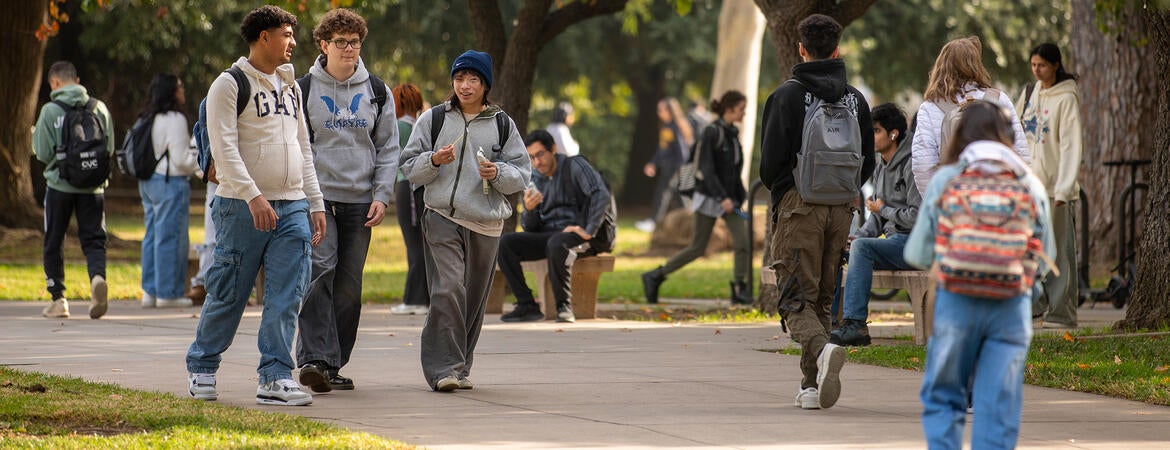
The inaugural sustainability literacy assessment drew responses from more than 2,400 students. It found that seniors scored significantly higher than freshmen, offering evidence that UCR students are learning key concepts related to environmental, social, and economic sustainability during their time at the university.
“This gives us a campuswide snapshot of what students know about sustainability and how that knowledge changes as they get closer to graduation,” Kristen Kopko, a researcher with the Center for Community Solutions, who led the research design and project management.
On average, students answered 68% of questions correctly on the 14-question assessment. Freshmen averaged a score of 61%, while seniors averaged 71% — a statistically significant difference that researchers say points to growth over the course of a UCR education.
The assessment was conducted by the Center for Community Solutions at the School of Public Policy in collaboration with the UCR Office of Sustainability. The report and assessment were co-directed by Juliann Emmons Allison, professor of society, environment and health equity and the faculty director of sustainability, and Qingfang Wang, professor in the School of Public Policy. Andrew Crosby, a public policy assistant professor, served as a survey expert and analyst.
To prepare for the assessment, researchers reviewed more than 400 sustainability and environmental literacy questions drawn from prior studies and other sources. Through multiple rounds of expert review, student testing, and statistical validation, the list was narrowed to 14 questions designed to measure students’ understanding of sustainability concepts across disciplines.
The assessment was administered online to all enrolled UCR students over two academic quarters in 2025. Responses were broadly representative of the campus population by college, class standing, and first-generation status.
Results also revealed disparities. First-generation college students scored somewhat lower than their non–first-generation peers, averaging 65% compared to 71%. Scores varied by academic unit as well, with School of Public Policy students posting the highest average score at 80%, and the School of Education posting the lowest at 60%.
The authors caution that the findings should be interpreted carefully. The assessment captures knowledge at a single point in time and does not track individual students longitudinally. The study also did not determine where the sustainability learning occurs. Beyond the classrooms, students also learn through family and social relationships, media exposure, extracurricular activities, internships, and campus culture. In addition, the assessment measures knowledge, not attitudes or behaviors.
Even so, the researchers say the results provide useful guidance for curriculum development and campus planning.
“This is about understanding how well we’re preparing students to engage with complex sustainability and environmental challenges,” Kopko said. “And it gives us a foundation to improve.”
The report, “Advancing Sustainability Literacy in the University of California: Experience and Findings from UC Riverside’s Inaugural Assessment,” was supported by the UC Office of the President and the Global Climate Leadership Council.