UCR marked a decade of advancing innovation by honoring three standout researchers during its inaugural Innovators of the Year awards, part of a broader 10-year anniversary celebration for the university’s Office of Technology Partnerships.
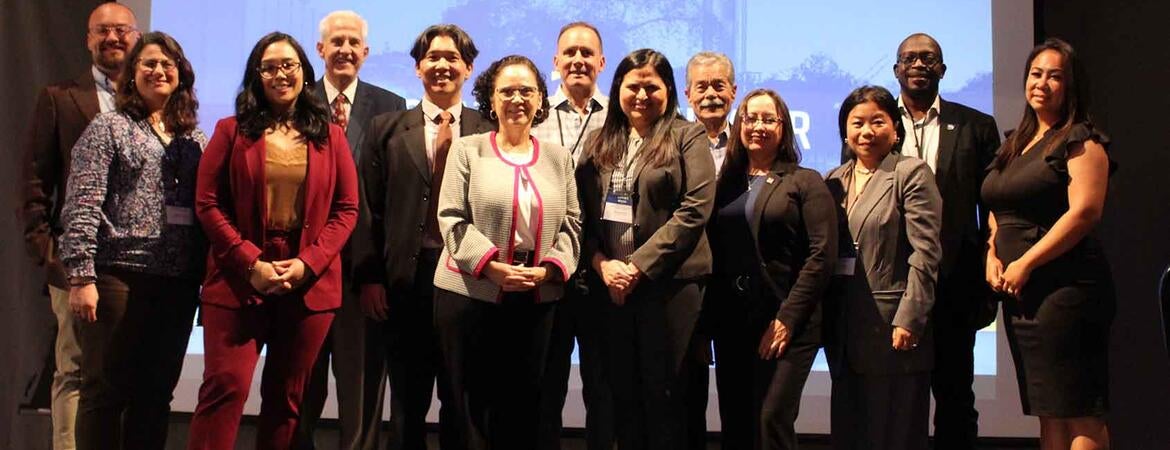
Held recently at the Culver Center of the Arts, the event highlighted the university’s role in turning research into real-world solutions. The awards recognized undergraduate student Cooper Proulx, graduate student Christopher Clark, and faculty member James Baird for innovations with strong societal and commercial potential, ranging from sustainable housing to medical technology and water-saving agriculture.

Proulx was recognized for leading the design and construction of a highly energy-efficient, transportable house built on campus. The 1,154-square-foot home uses solar power so efficiently it does not need to be connected to the electrical grid, eliminating utility costs for residents.
Proulx led a multidisciplinary team of students with no prior construction experience to create a house featuring a distinctive hexagonal design that reduces building materials, improves airflow, and minimizes direct sun exposure on walls. The result is a cooler structure requiring less energy for lighting and climate control.

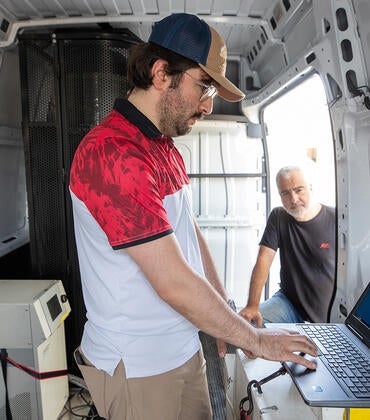
Clark, a graduate student in bioengineering, earned recognition for his work on a redesigned medical imaging device aimed at improving the diagnosis of hearing loss. The device — known as an Optical Coherence Tomography and Vibrometry Endoscope — allows clinicians to measure and visualize the middle ear with greater precision than traditional CT or MRI scans. Working as part of a student engineering team, Clark helped transform the device into a more compact, clinic-ready tool that could expand access to accurate hearing diagnostics worldwide. The project also earned national recognition through a National Institutes of Health design award.

Baird, a botany and plant sciences professor, was honored for developing a drought-resistant bermudagrass cultivar that could significantly reduce water use across Southern California landscapes. The grass, commercialized as Coachella™, maintains a green appearance while requiring less irrigation than conventional turf.
Licensed to industry partner West Coast Turf, the innovation is now targeted for high-water-use areas such as golf courses and sports fields, with potential expansion to residential lawns. The development aligns with regional efforts to conserve water amid ongoing drought conditions.
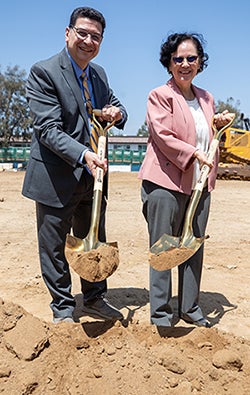
As part of the 10-year celebration, UCR also recognized members of the National Academy of Inventors, including fellows, senior members, and institutional members of the Inland Empire Chapter. This recognition highlighted UCR’s commitment to supporting inventors whose work advances science, technology, and societal impact.
Under the leadership of Rosibel Ochoa, associate vice chancellor for technology partnerships, the Office of Technology Partnerships, or OTP, has leveraged UCR’s innovations by supporting hundreds of startups advance their technologies and secure funding, strengthening industry partnerships, and turning research discoveries into real-world solutions.
Rodolfo Torres, the vice chancellor for Research and Economic Development, said OTP has had a transformative impact on campus and across the region by accelerating the translation of research into real-world solutions.
“It has helped position UCR as a powerful engine for innovation, entrepreneurship, and economic development,” he said.
The office has also assisted faculty in securing more than 210 patents and executed 71 licenses in the agriculture, life sciences, clean energy, and advanced materials sectors, which generate royalties that contribute to UCR’s financial stability. These and other accomplishments are detailed in the office’s 10-year report.
“Our journey is proof that strategic vision, persistence, and deep community collaboration are the true drivers of impact,” Ochoa states in the report. “The next decade will bring even greater challenges and opportunities, but our mission remains the same: to transform bold ideas into pathways of opportunity and to make Inland Southern California a model for inclusive innovation.”