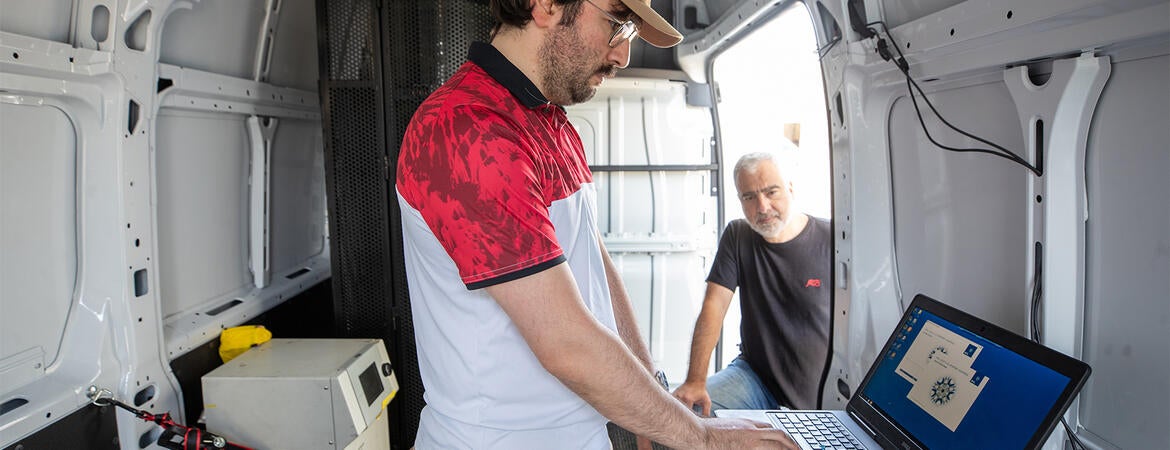
UC Riverside environmental engineers are testing a van imported from France with a hydrogen combustion engine as part of an international effort to advance decarbonization of the transportation industry and curb greenhouse gas emissions.

The van is being tested at UCR’s Center for Environmental Research and Technology, or CE-CERT, through a collaboration supported by the Hydrogen Engine Alliance of North America, an initiative launched last year by UCR, the University of Michigan, and industry partners to promote hydrogen-powered engines as a zero-carbon transportation option.
Georgios Karavalakis, a professor of chemical and environmental engineering at UCR and co-director of the alliance, said the project is the first major demonstration and testing effort of its kind in the United States for a medium-duty vehicle with a hydrogen internal combustion engine.
Originally a diesel-powered vehicle, the international company Phinia retrofitted the Fiat Ducato van with a hydrogen internal combustion engine, or H2-ICE. CE-CERT researchers will conduct extensive laboratory and on-road testing of the van to evaluate its performance, emissions characteristics, and overall operation. The results will be presented at scientific conferences and ultimately published in academic journals, Karavalakis said.
The testing effort also relies on advanced emissions-monitoring equipment provided by industry partners. AVL, a member of the alliance, supplied a portable system that measures vehicle emissions in real-world driving conditions with the same level of accuracy typically achieved in a laboratory. Sensors, Inc. also supported the project by providing portable equipment used to track and analyze emissions while the hydrogen-powered van is on the road.
The testing comes as hydrogen combustion engines are drawing increasing interest as an alternative to battery-electric vehicles for commercial and long-haul trucking applications. Hydrogen combustion engines are also gaining traction in Europe, where they are being classified as zero-emission technology for transportation applications. Hydrogen combustion engines burn hydrogen gas in a modified traditional engine and are different from hydrogen fuel cell engines, which use an electrochemical process to generate electricity to power vehicles.
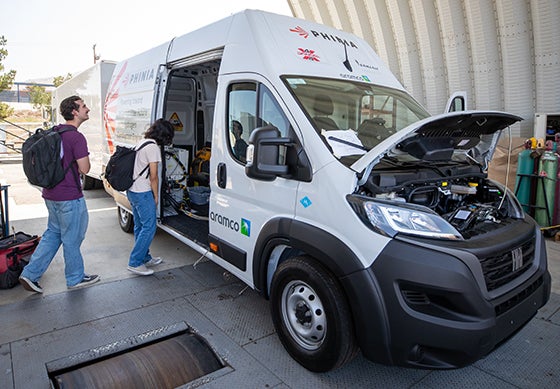
Karavalakis said major challenges in the U.S. include the lack of fueling infrastructure and the high cost of hydrogen. He compared the current state of hydrogen technology to where electric vehicles stood roughly 15 years ago, when charging stations were scarce, and public adoption remained uncertain.
“The technology is mature,” Karavalakis said. “Manufacturers know how to build these engines and these vehicles. What we need is the infrastructure, the fuel, and affordable green hydrogen.”
Hydrogen internal combustion engines offer a pragmatic path to zero-emission or near-zero-emission transportation vehicles and off-road equipment, Karavalakis said.
Researchers and industry leaders are also exploring ways to produce hydrogen using renewable energy sources such as solar, wind, biomass, and nuclear power. Such “green hydrogen” can be created through electrolysis, a process that uses electricity to split water into hydrogen and oxygen.
Header image: Zisimos Toumasatos, an research engineer, and Professor Georgios Karavalakis, run tests in a hydrogen fuel van. (UCR/Stan Lim)