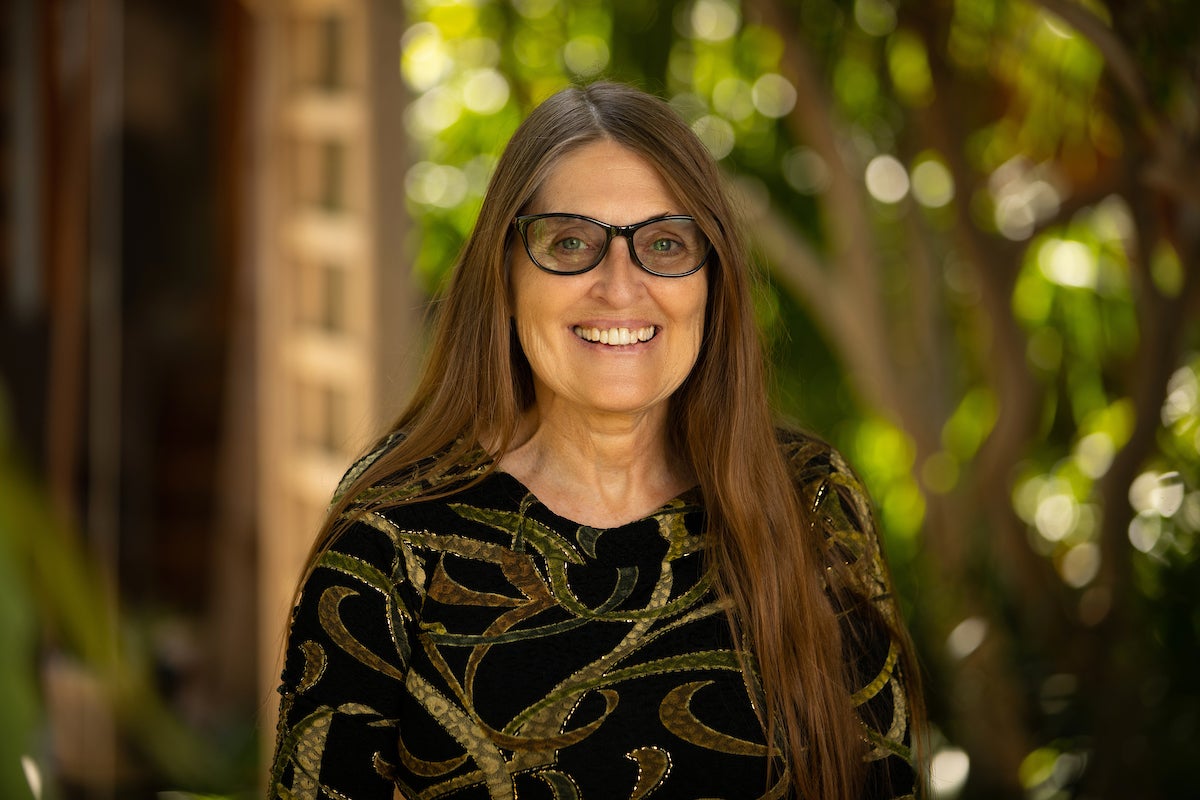
A multimedia concert celebrating the 250th anniversary of America’s founding spotlights a famous poem by Allison Hedge Coke, distinguished professor of creative writing at UC Riverside.
Hedge Coke’s “America, I Sing You Back,” published in 2011, is one of three related poems that inspired “I Hear America Singing,” a traveling stage production that combines music, poetry, excerpts from the Declaration of Independence, and quotes from historical figures to explore the nation’s founding ideals and ongoing struggle to realize them.
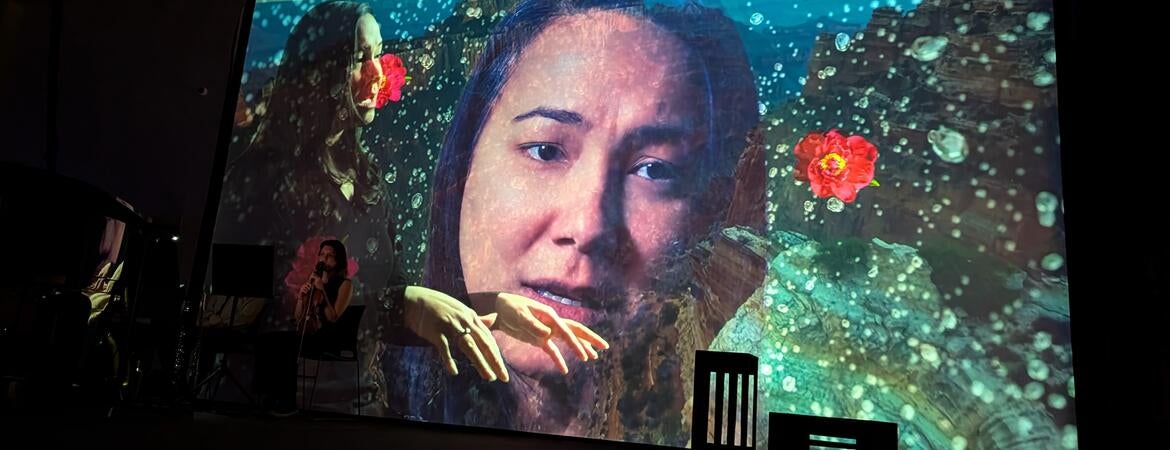
A video of the actress Rinska Carrasco reading Hedge Coke’s poem is shown as the performance opens. In addition, the production’s namesake — “I Hear America Singing” (1860), Walt Whitman’s paean to the nation’s ethos of individuality, democracy, and industry — and Langston Hughes’ “I, Too” (1926), which augurs a future of equality and respect for Black Americans, are read by actors on video.
The husband-wife artistic team of Nathan Gunn and Julie Gunn created the show on behalf of the Peoria Riverfront Museum, in Illinois, to complement its exhibition titled “The Promise of Liberty,” guest-curated by documentary filmmaker Ken Burns. The museum “had asked us to artistically respond to the 250th anniversary of the Declaration of Independence,” said Julie Gunn, a musician and music director.
“We felt most at home with a lyrical or poetic, rather than a historical or political, response,” she continued. “Walt Whitman’s poem ‘I Hear America Singing’ emerged as a natural theme, and we wanted to think further about Americans from all times and backgrounds singing. When we found Allison’s tribute to that iconic poem, and that of Langston Hughes’, we knew we had it right.”
By combining music from multiple traditions with poetry, historical writings, and multimedia imagery, “I Hear America Singing” presents a broad portrait of America — one that embraces a diversity of voices, cultures, and experiences.
Whereas America’s 250th birthday festivities have in many cases been marred by partisan rancor, the Gunns’ production is animated by a theme of inclusion and indivisibility. In some measure it reclaims what the semiquincentennial should be about, Hedge Coke said.
Performances are scheduled for Aug. 21 in Algona, Iowa, and Sept. 10-11 in Urbana, Illinois. It was first performed in March at the Peoria Riverfront Museum, where its two-night run sold out.
Composed en route to Colombia
A longtime newspaperman turned poet, Whitman marveled at the diversity of ordinary Americans, and his poem conveys an expansive definition of the nation. Hughes and Hedge Coke expand that definition further, capturing, respectively, a view from Black America and the tension between colonization and the natural environment.
Hedge Coke said she wrote the poem in 2005 on her way to the Medellín International Poetry Festival in Colombia, which was then engaged in a multi-division civil war.
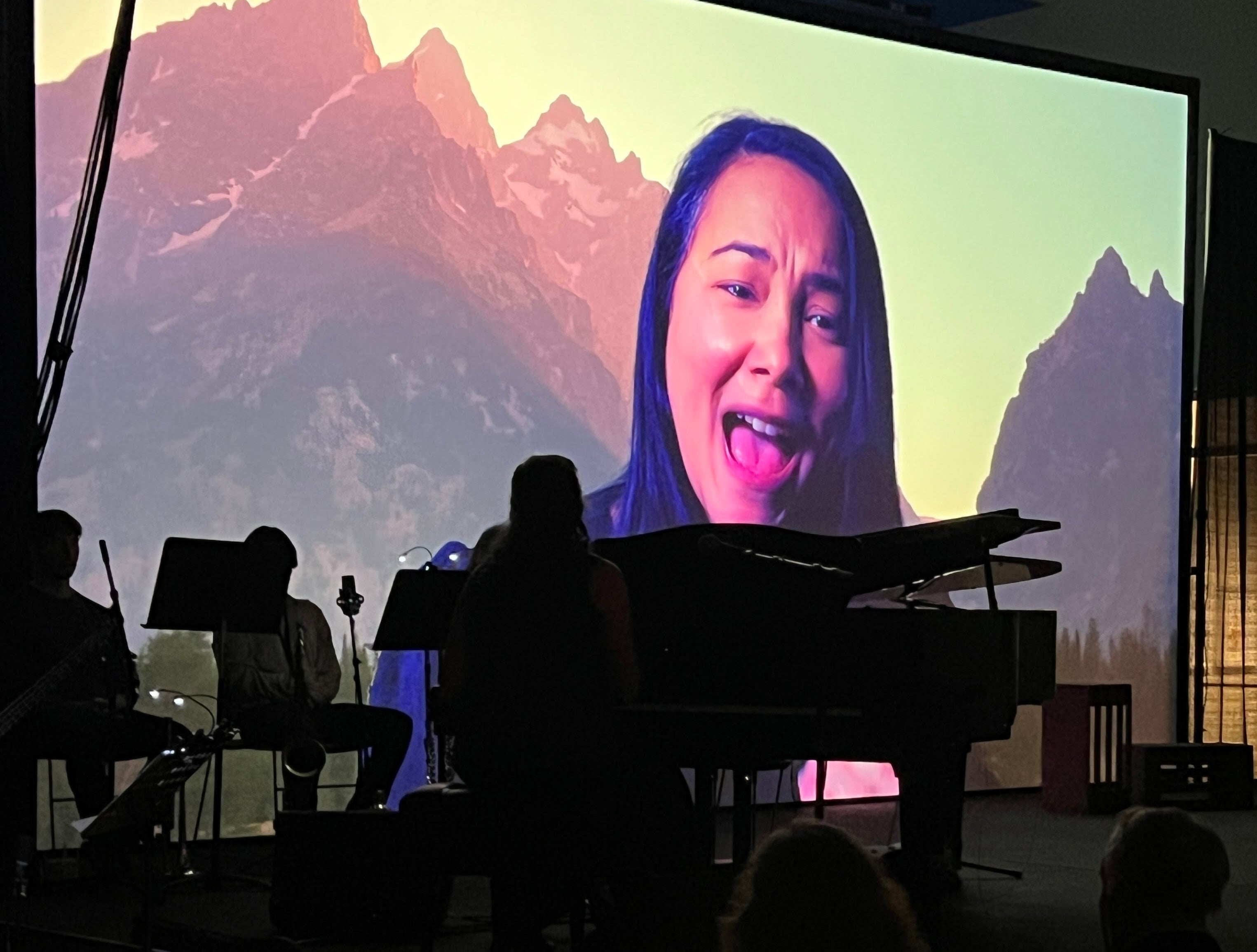
Carrasco recites "America, I Sing You Back." (Courtesy of the
Peoria Riverfront Museum)
“Going into that war zone, I was very aware of how much destruction war brings not only to people, but to the environment,” she said. “In Colombia specifically, these wars had been wiping out entire families and communities — Indigenous communities, Afro-Colombian communities in very rural areas — alongside causing widespread ecological devastation. I wanted to put something in the air that called back a time of consideration for people and planet — something with the energy of call and response, asking for a return to peace and to a more rooted relationship with the places we inhabit.”
In addition to her father and uncle, Hedge Coke dedicates the poem to Whitman and Hughes. It was published in an anthology, “Sing: Poetry from the Indigenous Americas” (2011), that she edited.
“I conceived the poem as a response to both Whitman and Hughes but from a female perspective, and from the perspective of someone with a deep kinship with the natural environment,” Hedge Coke said.
There is an interesting parallel between Whitman’s career and Hedge Coke’s: Both worked as manual laborers — Whitman as a carpenter and Hedge Coke in the tobacco fields of North Carolina and as a seasonal farmworker in other states — before turning to poetry.
Whitman celebrates the American laborer. He hears “varied carols” — “The carpenter singing his as he measures his plank or beam, / The mason singing his as he makes ready for work.”
Hedge Coke, however, goes in another direction, focusing on an America that has forsaken, or maybe just forgotten, its pre-Columbian roots. The voice in the poem is almost like a mother’s to a wayward daughter:
“When my song sings aloud again. When I call her back to cradle.
‘Love letter to America’
The poem emphasizes America’s endurance in spite of trauma and historical injustice, Hedge Coke said. It “‘sings back’ against a dominant national story that has ignored experiences of the original peoples and the land’s health.” “America” in the poem is meant to refer broadly to the Americas, she explained.
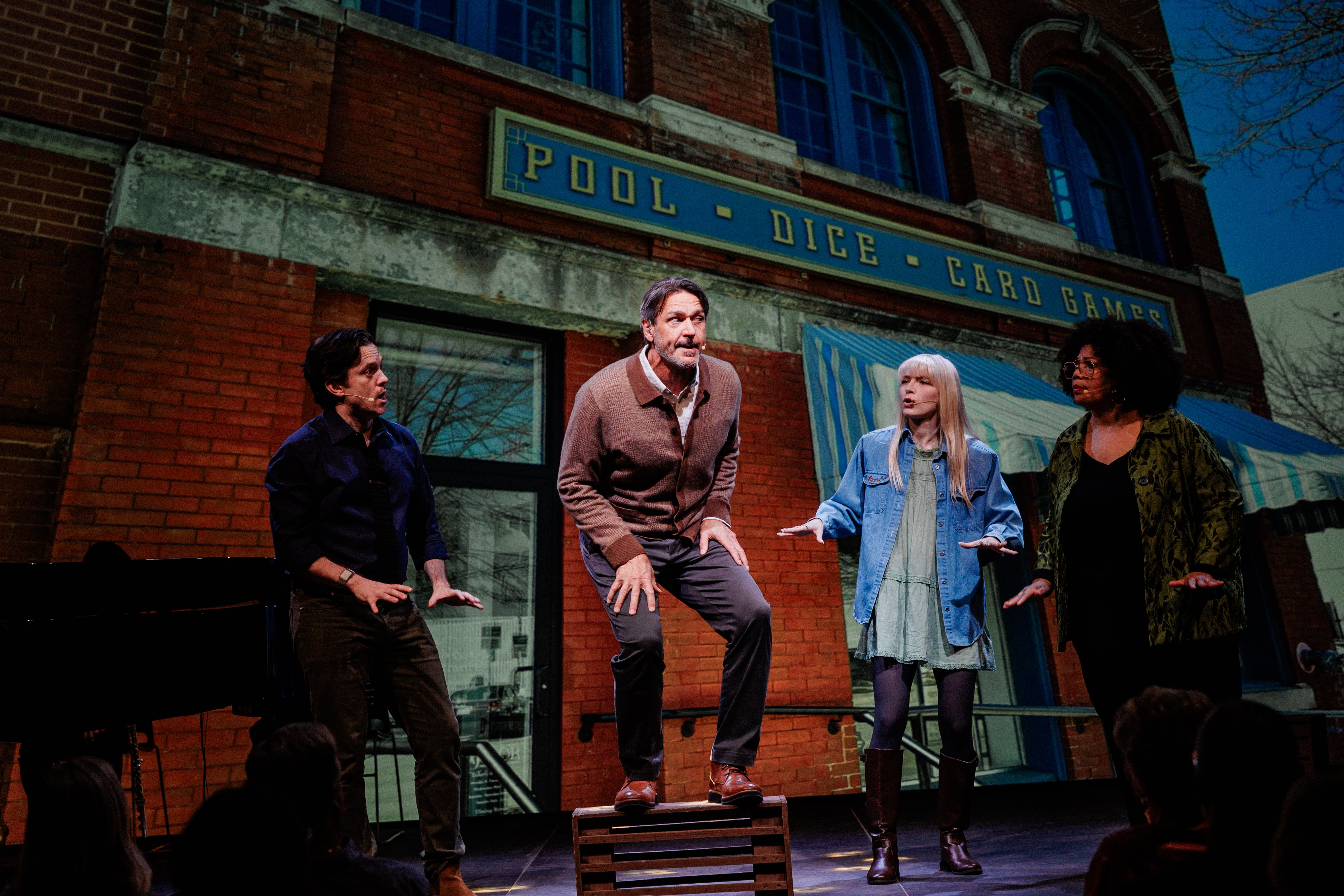
Danrich perform at the show’s premiere. (Courtesy of
the Peoria Riverfront Museum)
“The advent of European arrival changed everything,” she continued. “Jamestown, for instance, was founded essentially as a resource extraction operation — they came for lumber because they didn't want to deplete the forests closer to home. The outcome of that impulse was inevitable: You clear the land, you push out the people who are there. And it’s been devastation since.”
Hedge Coke’s poem is both an homage and a challenge. Borrowing the cadence and confidence of Whitman’s verse, she redirects the reader’s attention to the land and its longtime caretakers.
“The poem is a love letter to America — all of it — and it’s a call to accountability,” she said. “When you love someone or something genuinely, you love everything about them, including the quirks and the difficulties. But if something is wrong, it’s part of your responsibility in that relationship to name it and call for something better. That’s what the poem does.”
Top, Rinska Carrasco recites “America, I Sing You Back” in a video recording at the premiere of “I Hear America Singing.” (Courtesy of the Peoria Riverfront Museum)