Georgios Karavalakis, a UCR professor of chemical and environmental engineering, has been elected a Fellow of the Society of Automotive Engineers (SAE) International, one of the highest honors in the mobility engineering field.
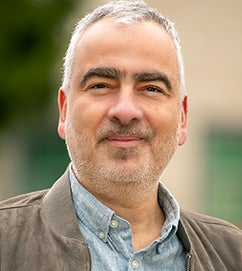
The honor recognizes Karavalakis for technical excellence for his scientific contributions to understanding the impact of engine technology, emissions control technology, and low- and zero-carbon alternative fuels on real-world vehicle emissions and their transformation into secondary aerosols.
The SAE announced Karavalakis’ selection in January. He will be formally inducted at the SAE Fellows Reception and Dinner in Detroit on April 13 ahead of the WCX World Congress Experience, SAE’s annual flagship event.
Established in 1975, the SAE Fellow designation honors outstanding engineering, scientific, and leadership accomplishments. Fewer than 20 individuals worldwide are typically inducted each year.
“It is a great honor to be elected as an SAE Fellow, and I am deeply grateful for the recognition by my peers who are advancing the development of sustainable low- and zero-carbon fuels for cleaner and more efficient transportation engines that benefit human health and air quality,” Karavalakis said.
Karavalakis is a professor in UCR’s Chemical and Environmental Engineering Department and an affiliated faculty member with the College of Engineering Center for Environmental Research and Technology (CE-CERT). Since joining CE-CERT in 2010, he has directed advanced studies on low- and zero-carbon fuels, alternative combustion strategies, and the environmental impacts of engine emissions.
A core part of his research is the better understanding of fuel compositional effects on primary and secondary emissions, and the physicochemical characterization of particle emissions from transportation sources, including the potential health effects of ultrafine particles. He is currently leading research programs to study the formation pathways and chemical nature of non-exhaust emissions, such as from brake and tire wear, from mobile sources, including airborne microplastic particle pollution.
His work with characterizing vehicle emissions was instrumental in California’s decision last year to increase the allowable proportion of ethanol in gasoline from 10 percent to 15 percent.
Karavalakis earned a doctorate in chemical engineering from the National Technical University of Athens, and master’s and bachelor’s degrees in environmental and mechanical engineering from the University of Portsmouth in the United Kingdom.