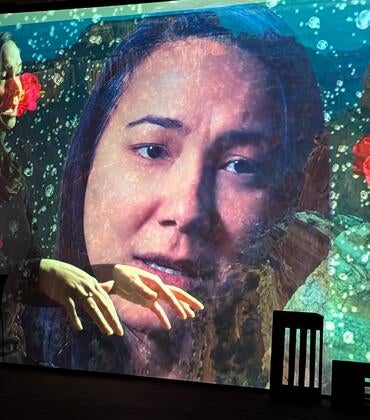
The UnMute Podcast marks its 10th anniversary this year, and for the first time the public philosophy series can be seen as well as heard.
Podcast host Myisha Cherry, associate professor of philosophy at UC Riverside, is posting video recordings of Season 10 episodes on her YouTube channel. The first dropped in early August and features Cherry in conversation with Joel Krueger, associate professor of philosophy at the University of Exeter, in England, on how AI can shape emotions and relationships.
“I’m a YouTube person myself,” Cherry said. “Once I recognized that I like to watch conversations, it seemed strange that my own conversations weren’t watchable.
By adding the visual component, Cherry hopes to broaden the program’s appeal. “I expected it to be extra work, and it is,” she said. “But it’s also satisfying a different kind of creative impulse I have, so I’m genuinely excited about it.”
Audio-only versions of the Season 10 episodes as well as all 71 episodes from previous seasons are available on the podcast’s website. For each episode, Cherry interviews one or more guests on subjects such as love, anger, forgiveness, extremism, racial justice, culture, and moral responsibility.
“I want listeners to see that the conversations happening in their group chats are also happening among philosophers — just from a different angle — and that the intersection of those two conversations makes for a good listening experience,” she said.
How it started
Cherry launched UnMute as a graduate student at the University of Illinois-Chicago. Her goal was to create a platform for the philosophical discussion of contemporary social and political issues, with a focus on the people and topics often overlooked by mainstream philosophy.
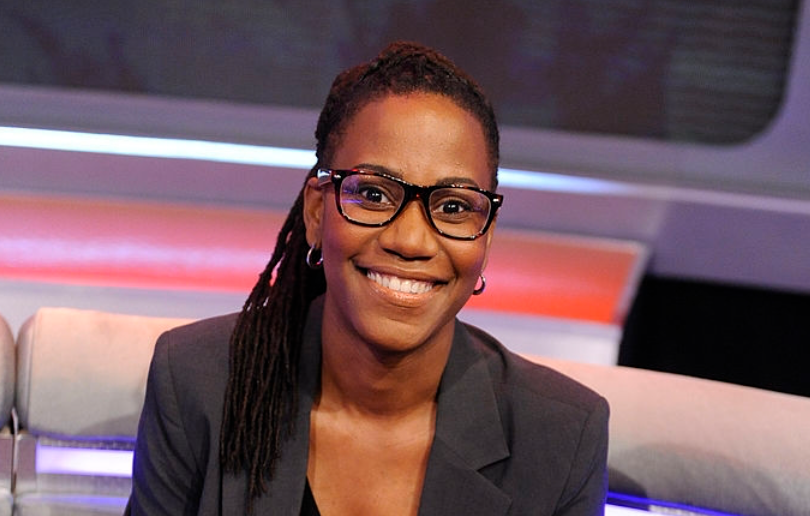
“In my first year of graduate school, I observed a hierarchy in philosophy as a discipline,” she said. “Certain analytic topics were considered the epitome of what philosophy is and what philosophers do, while topics such as feminism and race were treated as a lower tier. No one would say that explicitly, but it was the culture.”
One of the first questions she asks of guests on the program is how they became interested in philosophy. Cherry said her own interest was piqued in 1996 during her first semester at Morgan State University, in Delaware, where she had intended to major in communications. She was away from home for the first time and felt alone with her thoughts, she said.
“The combination ignited something I’d call a philosophical inclination,” she said. She was aware of philosophy as a vocation and familiar with people who pursued it; two of her earliest influences, she said, were the philosophers and leftist public intellectuals Cornel West and Angela Davis.
“By my second semester, without ever having taken a philosophy course, I decided I liked to think a lot, and I changed my major to philosophy,” she said. “There was really no deeper reasoning than that.”
After graduating, Cherry began working at WEAA, Morgan State University’s radio station, where she would sometimes cover for a Sunday talk radio host.
She also enrolled as a graduate student at Howard University in Washington, D.C., and couple of years later began co-hosting her own show at WEAA. After earning a master’s degree in divinity from Howard in 2003, she worked at several nonprofit organizations, including the Fortune Society, which helps people reenter public life after being incarcerated. She taught a summer seminar in philosophy at John Jay College, in New York, for former inmates.
When she enrolled in the graduate philosophy program in Illinois, she said she felt an internal schism — a sense that she was leaving her “on the ground” work behind.
“So, the podcast became a way to bridge the divide — a place where philosophers talk about things anyone can relate to,” she said.
Memorable episodes
Cherry said several episodes stand out in her memory. The Season Nine episodes about forgiveness were particularly meaningful to her, she said, because she had recently published a book, “Failures of Forgiveness” (2022), on the topic.
“It was a chance to talk to people I’d learned from while writing it,” she said. “Doing the podcast episodes after I’d finished the manuscript, yet still learning about forgiveness from these conversations, drove home something I talk about a lot: how essential humility is to learning, because you’re always, always learning.”
She also called out the earliest episodes of the podcast, when prominent professors were gracious enough to appear on a grad student’s show, as well as episodes with the philosophers Joel Reynolds, now at Georgetown University, on disability and well-being and Paul Taylor, now at UCLA, on Black aesthetics.
“My mother was disabled for her entire life, so I had the lived experience of it,” Cherry said. “But I’d never thought about disability intellectually, let alone philosophically. Talking with Joel, who’d also grown up around disability and who’d made it his philosophical focus, taught me an enormous amount.”
She continued, “And I consider Paul one of the most brilliant people of our generation. I learned so much from him about Blackness in art and aesthetics — Black invisibility, the connection between art and politics, cultural appropriation, beauty and race.”
A few years ago, Cherry considered discontinuing the podcast because of the time commitment it required. But she said anecdotal evidence of the show’s impact — listeners who have said they began studying philosophy because of the podcast or learned something profound from one of its episodes — makes it hard for her to stop.
“Philosophers spend years writing academic papers that for the most part only people in our field read, so people genuinely don’t know what we’re thinking about,” Cherry said. “The podcast is a way of saying, ‘We have something to say, and it’s worth hearing — not because we’re thinking something you haven’t thought about, but because we want to think it through with you.’”
Top, Myisha Cherry interviews Joel Krueger on an episode of The Unmute Podcast. (Courtesy of Myisha Cherry)