
UC Riverside education scholars have won nearly $600,000 in federal funding to help science and engineering undergraduates overcome learning stumbling blocks in introductory chemistry, calculus, and physics courses.
A $596,495, three-year grant from the National Science Foundation will bring together experts in education, mathematics, and chemistry to develop new ways of teaching difficult STEM concepts.
Rather than relying on lectures and textbooks, the researchers will explore “embodied learning” techniques to help students understand abstract ideas.

“Students can struggle in introductory STEM courses not because they lack the ability to succeed, but because some of the concepts are extraordinarily difficult to visualize and understand,” said grant project leader Catherine Lussier, an associate professor teaching in the UCR School of Education.
“We want to give instructors additional tools for helping students make those concepts more concrete and, ultimately, help more students succeed in STEM,” she said.
Lussier will lead the project with co-principal investigator Kinnari Atit, an associate professor who co-leads the STEM Teaching and Learning Lab at the School of Education.
They will collaborate with co-principal investigators Jack Eichler, a professor of teaching in UCR’s Department of Chemistry, and Bryan Carrillo, an associate professor of mathematics at Saddleback College in Mission Viejo, Calif.
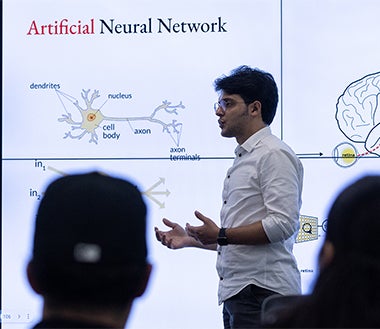
Embodied learning uses the body and senses — including gestures, movement, spatial reasoning, and visual representations — to help students understand abstract concepts. Unlike traditional teaching, it gives students physical and visual ways to think through complex ideas and connect abstract concepts to representations they can see or experience.
Researchers will work with instructors to help them incorporate embodied-learning techniques into their courses and study which approaches prove most useful for faculty and students.
“Our goal is to work alongside faculty to develop practical, research-informed ways of making difficult, abstract concepts more accessible to the everyday student, and then study how those instructional changes influence students’ learning and experiences for the better in these courses,” Lussier said.