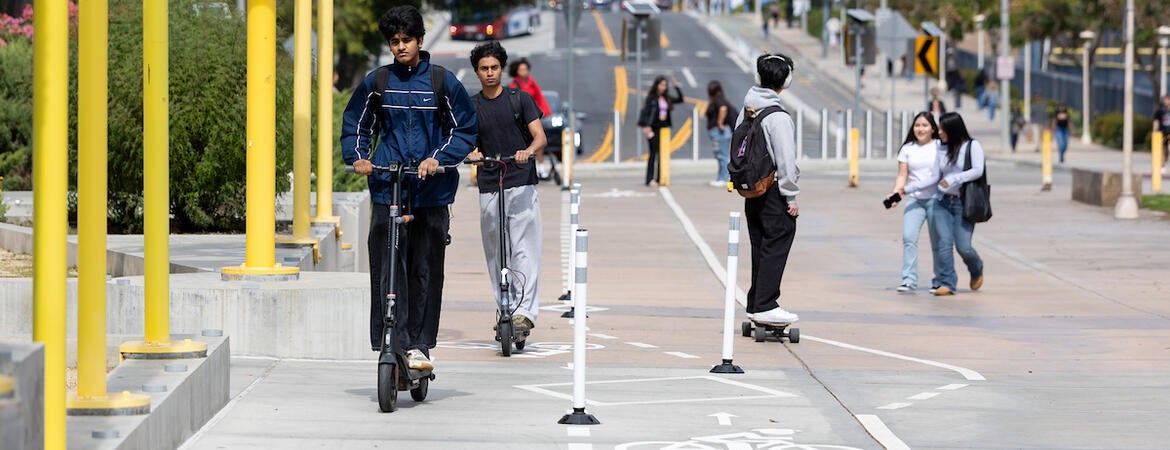
UC Riverside is testing out a dedicated pathway for bicycles, scooters, and skateboards in front of the Arts Building.
The new bike lane was installed in February and is part of a pilot program that will run through the end of the spring quarter.
Although the campus has bike lanes on its roads, the new pathway is the first in an internal corridor.
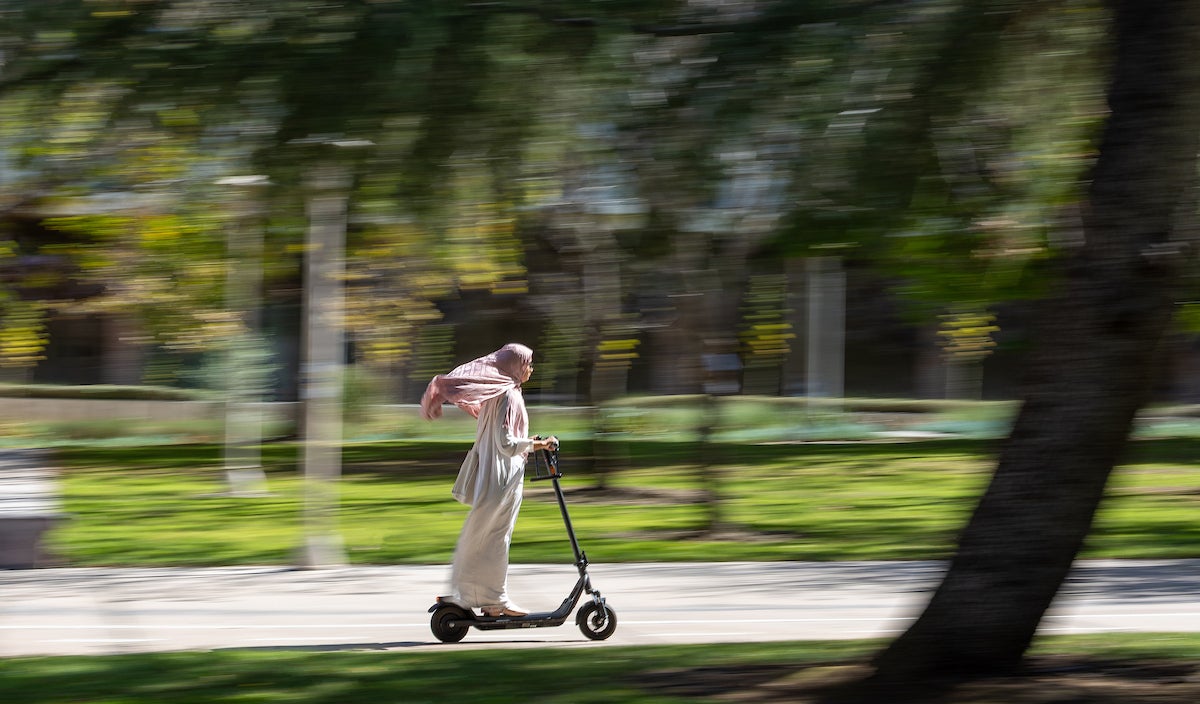
The goal is to see if bicyclists, scooter riders, and other micromobility device users will use the lane and if it will increase safety for them and pedestrians, said Kevin Gutierrez, a campus resource officer with UCR Police and Campus Safety. Gutierrez is monitoring its use with a team of student researchers.
The lane was installed without any advance notice, but most riders have taken to it, he said.
“We wanted to see the reaction of the campus community to it,” Gutierrez said. “There’s almost a herd mentality where they find their way to the lane.”
The pathway has a five-foot-wide lane in each direction and is about 500 feet in length from the area past the flagpole to the intersection of Canyon Crest Drive and University Avenue. It includes bicycle lane symbols, diamond symbols at intersections for pedestrians, and delineator poles between the two sides of traffic.
A sandwich board at either end advises riders to slow down to the 8-mph speed limit and includes other safety information.
The pathway is made up of a vinyl tape installed over two days that can be removed without damaging the concrete, said Melissa Garrety, a senior campus planner with the Office of Planning, Design, and Construction, which oversaw the installation.
“If you provide the lane people should use it by and large,” she said. “If they’re using it and going the appropriate speed we should see a reduction in accidents. But really, it’s an experiment to see if this will work.”
The location was selected because it has enough space to accommodate the lane and is considered a hot spot for accidents, injuries, and thefts based on monthly data collected by the police department, said Kritika Gupta, research and evaluation manager with the Health, Well-being and Safety division.
The project was proposed by the campus Micromobility Safety Committee, a group comprising several departments that has been coordinating outreach, education, and infrastructure efforts.
In student surveys and focus groups, many said they’d like to see more campus infrastructure to accommodate scooters, bikes, and other wheeled devices, Gupta said.
Student researchers are tracking the speeds of riders using a Light Detection and Ranging, or LiDAR, scanner most of the day, Monday through Friday. They are also noting how many are wearing helmets, headphones, or earbuds, and other safety-related information.
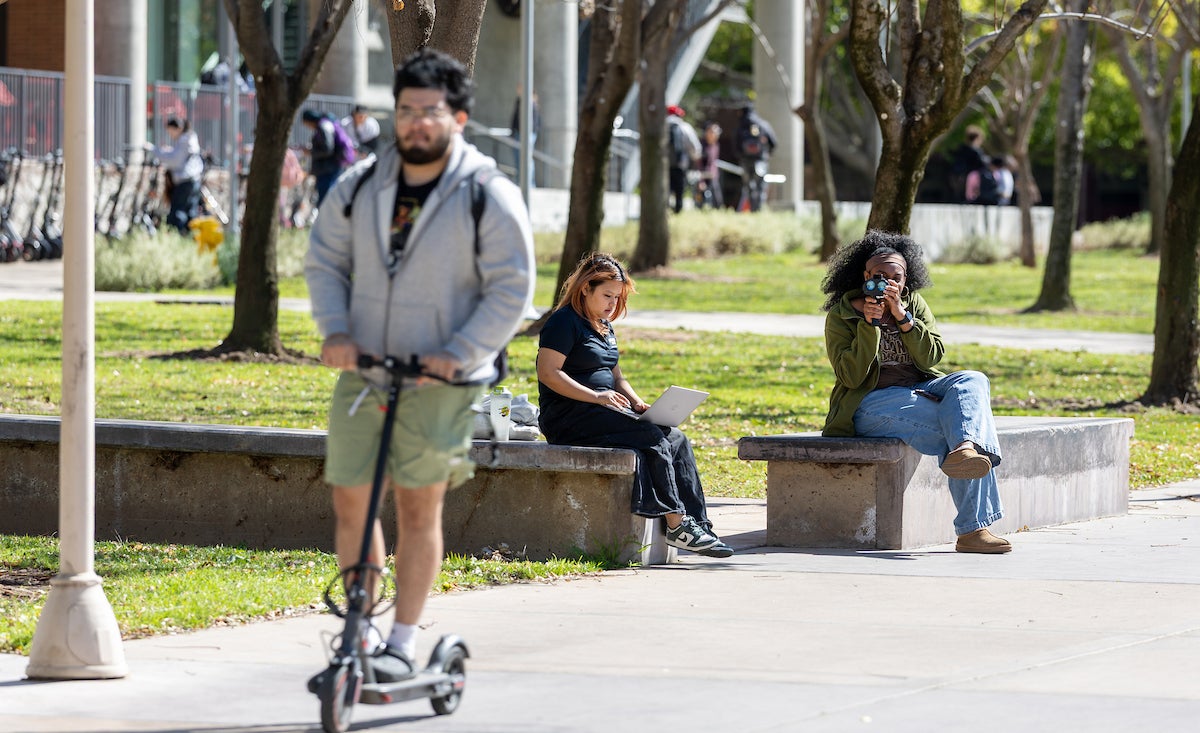
Early data shows that 73% of riders are already adhering to the lanes, Gupta said. Focus groups have also shown many are pleased to see that pedestrians and riders are in separate paths, already making it safer, she said.
At the end of the spring quarter, the data collected by researchers will be assessed by the committee and shared with campus leadership to determine whether to keep the lane in place and expand it to other locations, said Shalaurey Jones-Consalvo, strategic initiatives and special projects manager with Health, Well-being and Safety. She, Gupta, Gutierrez, and Garrety are all members of the Micromobility Safety Committee.
The pilot project is part of an overall effort focusing on educating riders and incentivizing safety. Bikes, scooters, and other devices have continued to grow in popularity and for many students are their only mode of transportation to get to classes and shop for food, Jones-Consalvo said.
The pilot project is an opportunity to reconsider how to get riders to move safely through campus, she said.
“We want to recreate our campus culture where the pedestrians and riders are co-existing and are respectful of one another,” she said.