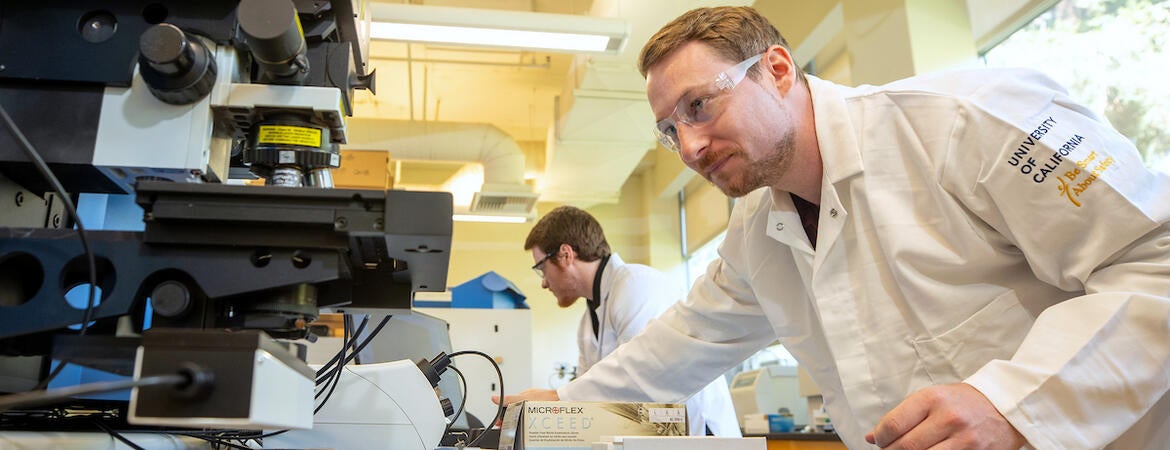

A new laboratory at UC Riverside is giving scientists cutting-edge tools to investigate one of humanity’s most fundamental questions: Is there life beyond Earth?
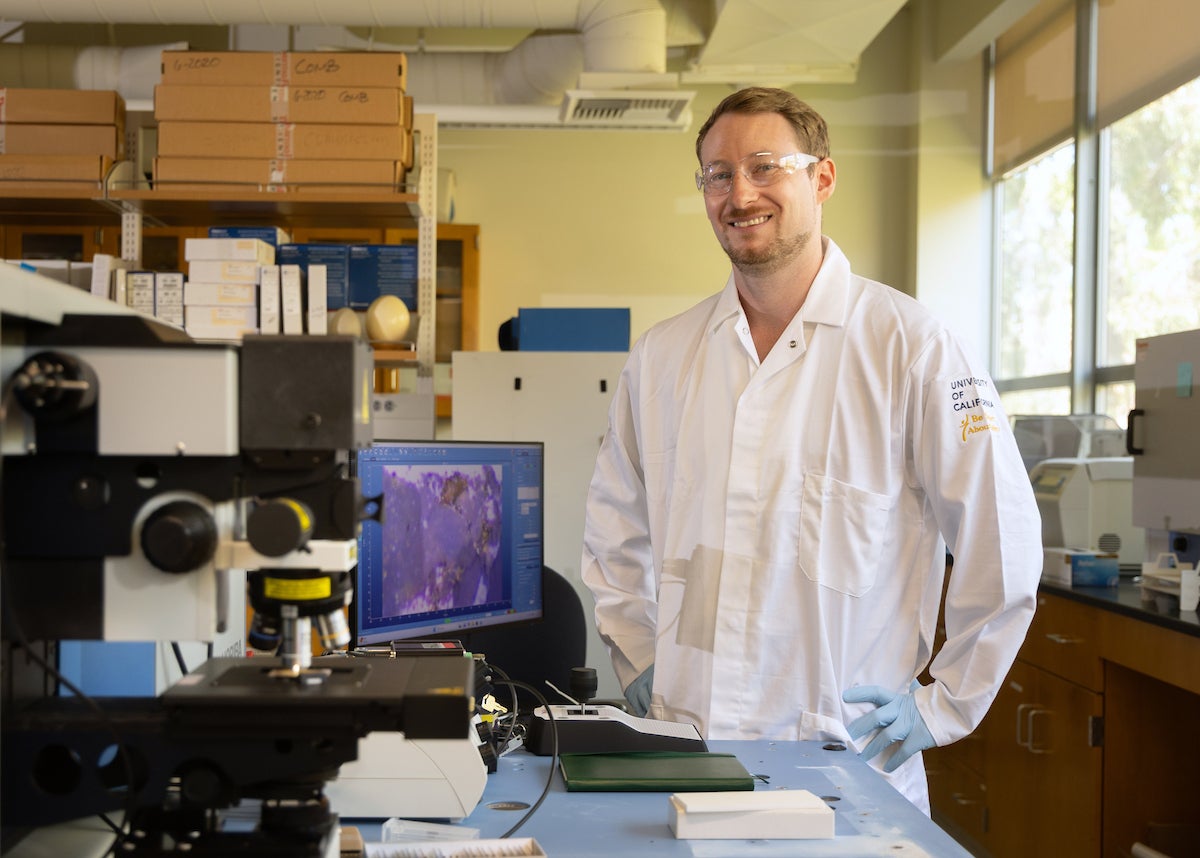
The Planetary Geochemistry and Astrobiology Laboratory is led by Assistant Professor Fabian Klenner, a new faculty member in UCR’s Department of Earth and Planetary Sciences. His research focuses on the habitability of icy moons and ocean worlds, using laboratory experiments to understand the chemistry and physics of environments where life might exist today and where evidence for its past presence could be detected.
That includes moons of Saturn and Jupiter as well as asteroids. By recreating key parts of these environments in the laboratory, Klenner’s team can investigate how minerals and salts interact, how materials freeze and melt, and how potential signs of life might survive and can be detected under conditions very different from those on Earth.
“Spacecraft data alone cannot tell us everything,” Klenner said. “We often have to recreate conditions in a lab to make sense of what we observe in space.”
Klenner, who was hired in December 2025, inherited laboratory space and equipment from a previous faculty member. During his first nine months at UCR, he has worked to expand the lab’s capabilities, including the addition of a cutting-edge differential scanning calorimeter and a state-of-the-art Raman spectrometer.
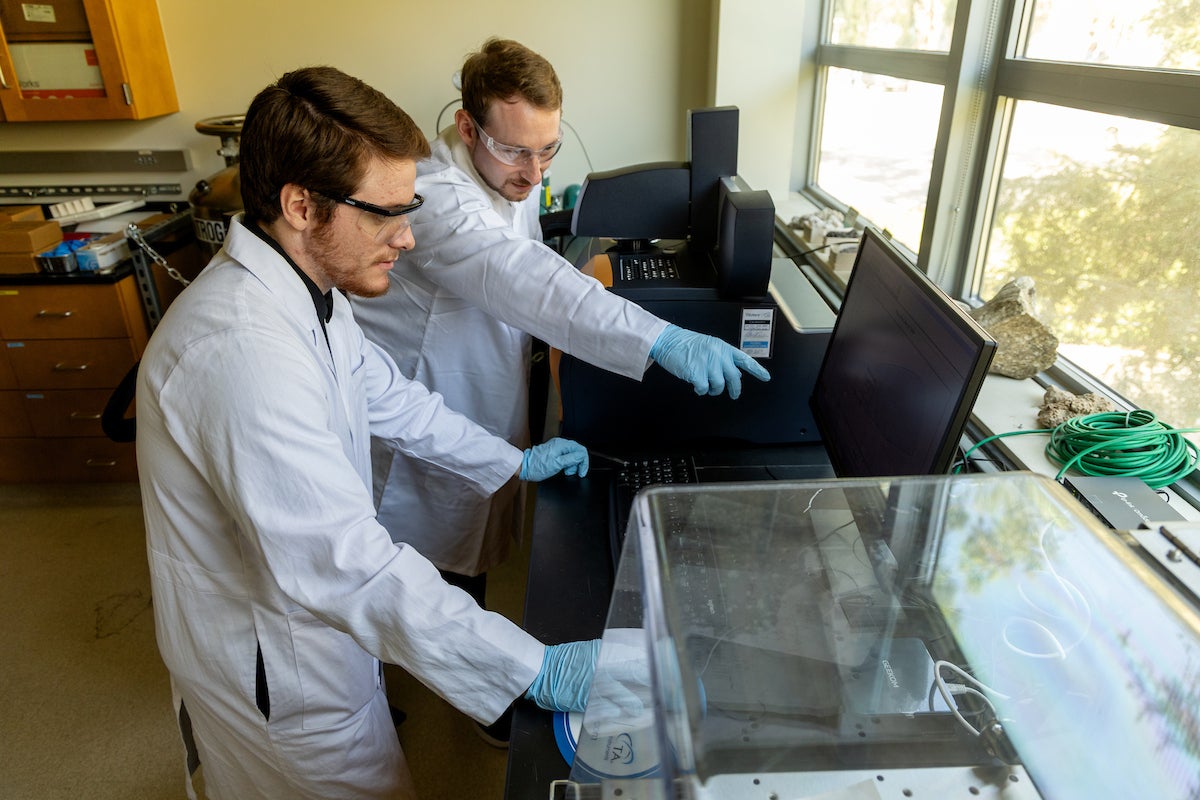
The calorimeter allows Klenner and his students to examine how materials respond to changes in temperature. “Connected to a liquid nitrogen source, the instrument can reach extremely cold temperatures relevant to icy moons,” Klenner said.
Researchers can use it to study processes such as crystallization and melting and determine how materials change under different conditions. They can also use it to learn how those changes may enhance or mask the records of possible life. While the technique is commonly used in materials science at higher temperatures, Klenner is applying it to the extreme cold characteristic of icy worlds far from Earth.
The Raman spectrometer provides another piece of the puzzle: composition. Combined with a microscope, it allows researchers to determine what materials are made of and investigate how their components separate or interact upon freezing. The instrument can analyze solids, powders, and liquids, thus elevating its relevance in the search for distant life.
The two instruments join two mass spectrometers already in the laboratory. One provides compositional information about gases and organic compounds, while the other can reveal information about isotopes in organic compounds.
Taken together, the instruments give Klenner’s lab a powerful suite of analytical capabilities for investigating the habitability of other worlds and interpreting observations returned by planetary missions.
The laboratory also creates teaching and research opportunities for UCR students and for collaborations on and off campus. Students working with Klenner are gaining hands-on experience with advanced analytical techniques used in planetary science and astrobiology while contributing to research on the search for life beyond Earth.
One student working in the lab this summer, Taveed Tamarin, came with a stipend to support his work through the NASA Europa ICONS program. This program pairs undergraduate students with Europa Clipper mission science team members to conduct original research on Jupiter’s icy moon.
“In my project, I’ve used differential scanning calorimetry to study how Europa-relevant saltwater solutions behave as they freeze, which provides context for the interpretation of future Europa mission data,” Tamarin said.
“It has been especially rewarding to develop practical lab and data-analysis skills while learning more about icy ocean worlds and research into planetary habitability. I love that these lab experiments may help us find life elsewhere in the solar system.”
Many scientists argue that these icy worlds provide some of the most promising possibilities for life beyond Earth.
Klenner credits the Department of Earth and Planetary Sciences with strong support in establishing the laboratory and acquiring the new equipment.
“Of course, I had a lot of support from others,” Klenner said.
Tim Lyons, distinguished biogeochemistry professor, joined the UCR faculty more than 20 years ago as a step toward building a world-class program in planetary science and astrobiology. He said he is delighted to have helped catalyze the addition of Klenner’s laboratory with funds that he and Emeritus Professor Mike McKibben secured from the Department of Energy.
“This cutting-edge lab, in addition to its far-out relevance, will contribute to research and student training for the critical mineral industry, with strategic value much closer to home,” Lyons said. “The one-two punch of this addition is fantastic and may very well change our fundamental understandings of life far above as well as the minerals beneath our feet.”