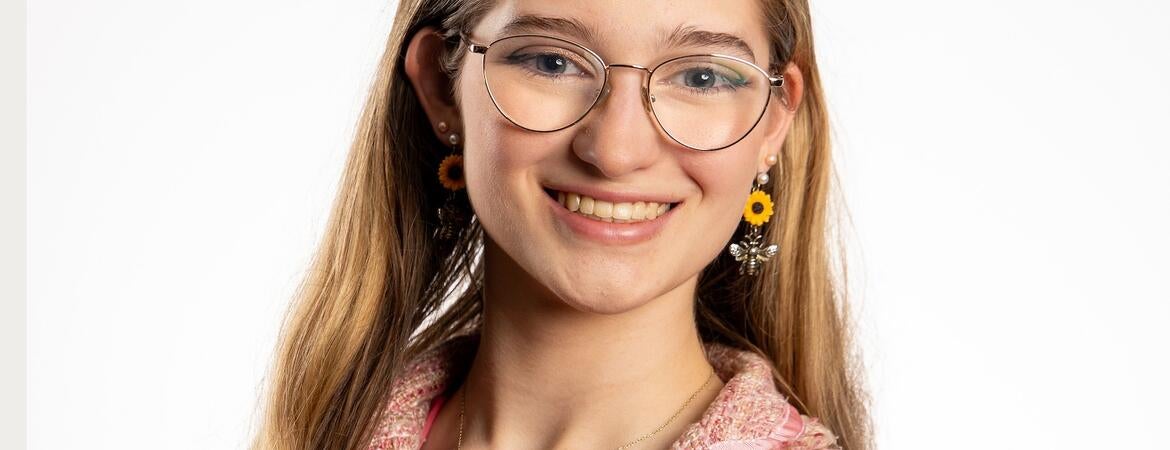

When Emilia Burnham walks into a classroom wearing a pink outfit, a lab coat, and a tiara, kids notice. That’s the point.

As the 2025 American Honey Princess and a master’s student in entomology at UC Riverside, Burnham has found a unique way to connect with schoolchildren, inspire future scientists, and advocate for one of the world’s most important creatures: the honeybee.
“I wear the tiara to attract attention,” she said with a smile. “Then I turn that attention to the bees.”
Being named the American Beekeeping Federation’s national princess is no small honor. For more than 80 years, the federation has represented beekeeping operations both large and small across the country.
Their princess award follows a highly competitive process. In 2024, Burnham served as the California Honey Queen, conducting statewide outreach to K-12 youth groups, schools, and community programs about honeybee health.
Having served in the statewide role made her eligible to compete for the national title, which she won. This gave her an even bigger platform from which to educate kids about insect science.
Burnham, a fourth-generation beekeeper from Murrieta, California, has spent the past year in this role on food floats at the State Fair of Texas, on the radio in Kentucky, or giving talks about bee health at a pumpkin patch in North Dakota.
“There’s no typical day as a honey princess,” she said. “Every day is a little wild and super interesting.”
Whether she’s teaching kindergartners how pollination works or answering high schoolers’ questions about being a woman in science, her message is clear: science is for everyone.
“You don’t have to wait until college to be curious,” she said. “You can ask questions, do your own experiments, and care about the world around you. And you can start now.”
That philosophy is personal. Burnham didn’t plan to become a scientist. Her parents encouraged her to go into medicine, but a chance visit to UC Riverside’s Highlander Day in 2019 changed everything. She stumbled across an observation beehive and struck up a conversation with UCR entomology professor Dong-Hwan Choe. For the first time, science felt alive.
“I realized that science is more than just cells and microscopes. It’s more than what you see on TV, and I could see myself in it,” Burnham said.
Roughly one out of every three bites of food people eat is made possible by bees, which are essential for pollinating 80% of U.S. crops. But bees aren’t doing well. Last year, for a variety of reasons, more than 60% of commercial beehives collapsed, putting food security at risk.
Burnham decided she wanted to be part of the solution to this problem. At UCR, she dove into entomology, despite being allergic to bees, honey, and even ants.
“People always ask me why I chose this field,” she said. “But it’s not about being comfortable. It’s about making a difference.”
Her research focuses on Nosema ceranae, a microscopic parasite that infects honeybee colonies. She’s studying how different bees’ immune systems respond to the parasite, and why some appear to survive better under stress.
The research is meaningful to her. But it’s the classroom that really lights her up.
Before being named American Honey Princess, Burnham served as UCR’s Entomology Department outreach coordinator from 2022–24, leading science visits to local schools. She plans to keep growing as an educator. In January she’ll start a Concordia University credential program to become a high school science teacher.
“Going into classrooms these past three years has felt like the universe poking me,” Burnham said. ‘It was saying, ‘Hey! You’re enjoying this, and it’s good for you! This is what you’re meant to do.’”
Her presentations blend fun with facts. Elementary students flap their arms like bees. Middle schoolers roll their eyes, until she wins them over. High schoolers ask deep questions about STEM careers and what it’s like often being one of the only women in a lab.
And always, she’s herself.
“I wear pink. I wear the princess tiara. I don’t try to be someone else,” she said. “That’s part of what I want students to see. You don’t have to fit into a mold to belong in science.”
Most of all, she tries to impart the message that kids can have an impact on the environment.
“Making the world a better place for all animals, including bees, can be as simple as not leaving trash out on the playground,” she said. “And there are things they can do at home too, like planting pollinator gardens.”
In between classes and cross-country travel, she still finds time to do ballroom dancing, play the flute, bake chocolate chip bagels, and create art. Her undergraduate capstone project combined bees, arthritis, and movement, using dance to explain how bee venom might help treat inflammation.
“Science and creativity are completely intertwined,” she said. “They’re both about seeing the world in new ways.”
So, when she stands in front of a classroom, tiara gleaming, telling kids they can change the world, she means it. And quite often, they believe her.